NACHHALTIGE FÜHRUNG IN EUROPA

invert-bottom-triangle

Der Bericht “Nachhaltige Führung in Europa”, dessen Zusammenfassung hier auch auf Deutsch verfügbar ist, bietet einmalige Erkenntnisse zum Zustand von Nachhaltigkeit in Europa’s Management. Die Studie wurde von Alberto Pastore (Professor an der Sapienza Universität von Rom) und seinem Team im Frühjahr 2020 durchgeführt.  Sie basiert auf einer Umfrage mit mehr als 1500 Führungskräften aus sechs europäischen Staaten (Deutschland, Frankreich, Spanien, Italien, Polen und Dänemark). Die empirisch begründeten Ergebnisse liefern wichtige Lehren für Politiker, Sozialpartner und Bildungseinrichtungen, insbesondere zur Kluft zwischen politischen Nachhaltigkeitszielen und der Realität der Arbeitswelt europäischer Führungskräfte.

Die Studie hatte zwei Hauptziele:

1. Ein empirisch begründetes, nachhaltiges und neues Leadership-Modell für Führungskräfte zu entwickeln

2. Ein Weiterbildungsprogramm für die spezifischen Bedürfnisse von Führungskräften zu entwickeln, um sie beim Wandel zu einem neuen Managementstandard zu unterstützen

Auf dieser Seite finden Sie die deutsche Zusammenfassung des Berichtes, sowie die Originalfassung auf Englisch. Zudem stellen wir ihnen einen Überblick der wichtigsten empirischen Ergebnisse der Studie zu Verfügung. Die englischsprachigen Grafiken sind in vier verschiedene Kategorien unterteilt: Wissen, Kompetenzen, Werte und Verhaltensweisen. Alle Informationen auf dieser Seite basieren auf der Originalfassung der Studie “Sustainable Leadership in Europe”.

Bitte beachten Sie, dass die Studie in den sechs Sprachen der teilnehmenden Länder durchgeführt wurde und die englische Originalfassung der Studie diese sematischen Differenzen nicht immer widerspiegelt.

Sustainable Leadership in Europe Report (Originalfassung)

invert-bottom-triangle

Wichtigkeit von Nachhaltigkeit für Führungskräfte

Obwohl Nachhaltigkeit für Führungskräfte insgesamt sehr wichtig ist, hat die Studie gezeigt, dass dies weniger der Fall für deren Führungsaufgaben ist, insbesondere in den Bereichen Umwelt und Unternehmensführung (governance).

Extrem wichtig
0%
Sehr wichtig
0%
Moderat wichtig
0%
Wenig oder nicht wichtig
0%

Zusammenfassung

Die deutschsprachige Zusammenfassung gibt einen Überblick über das thoretische Modell, sowie die empirischen Ergebnisse der Studie. Sie stellt die wichtigsten Erkenntnisse für Politiker, Führungskräfte und andere Akteure dar.

invert-bottom-triangle

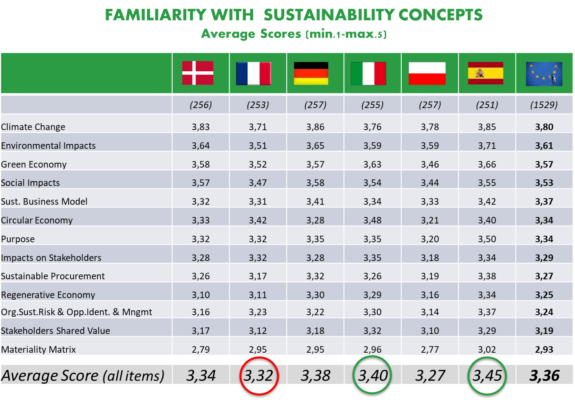
Sustainable Leadership Knowledge

Knowledge on sustainability issues

Percentage of managers who are familiar with the following items.

Respect of human rights
0%
Diversity and equal opportunities
0%
Freedom of association
0%
Reduce use of natural resources
0%
Environmental sustainability in value chains
0%
Paris Agreement
0%
European Green Deal
0%
EU non-financial reporting directive
0%

Sustainable Leadership Values

  • Quality of life

    The material requirements of well-being will have been met, and quality of life will be defined by fulfillment, not wealth.

  • Human solidarity

    Human beings will connect in solidarity with the needs, hopes and aspirations of those who live in distant places and future generations.

  • Ecological sensibility

    Nature will be valued as a source of all that supports humans and the entire web of life, as well as a source of endless wonder and enjoyment.

Sustainability values of managers

(extremely and very important)

These results cannot be considered positively, since the motivation necessary for a profound transition process must be very strong and the identification with these values shall be widely spread.

Quality of life
0%
Human solidarity
0%
Ecological sensibility
0%

Sustainable Leadership Skills

Proficiency of Sustainable Leadership Skills

    In this section, responding managers were answering with little differences between the items, indicating a rather low familiarity with the issues.

    • France stands out for “I have the ability to identify the main relevant impacts, positive and negative, that my organisation generates on the entire ecosystem of stakeholders and I have capacity to measure, account and report Sustainability”.
    • Spain is noticeable for “I have capacity to measure, account and report Sustainability and I am able to develop and implement sustainable business models, that are oriented not only to profit, but which integrate people and planet Sustainability into long-term business strategies”.


    Context understanding skills of Senior Management

    Context Understanding skills is an area with one of the lowest result in the survey, both in the self-assessment as well as the assessment of Senior Management (see graphic below). Better understanding the context seems to be a priority area for developing trainings for managers.

    Excellent
    0%
    Good
    0%
    Average
    0%
    Below average and poor
    0%

    Members of CEC European Managers fare better in soft skills

    In a special complement to the research, it was found that managers affiliated to CEC European Managers generelly score better results for the skills, especially in the soft skill area. This may indicate that managers with a membership in trade unions or manager association benefit from better skill development than other managers.

    CEC Database

      General Survey

        Sustainable Leadership Behaviours

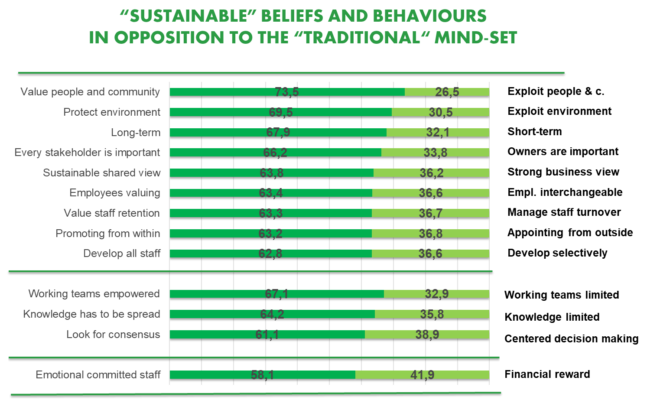
        Sustainable or traditional mind-set?

        Identification with Sustainable behaviours

        (figures for high self-identification)

        Practicing social dialogue
        0%
        Ensuring decent working conditions
        0%
        Compelling sustainability vision
        0%