RAPPORT SUR LE LEADERSHIP DURABLE EN EUROPE

invert-bottom-triangle

Le rapport sur le « Leadership durable en Europe », dont le résumé est disponible ci-dessous en français, offre des informations importantes sur l’état de durabilité dans l’encadrement en Europe. L’étude a été réalisée par Alberto Pastore (Professeur à l’Université de Sapienza de Rome) et son équipe en printemps 2020. Sur la base d’un sondage auprès de plus de 1500 cadres dans six pays européens (France, Allemagne, Espagne, Italie, Pologne et Danemark), les résultats empiriques offrent des constats pertinents pour les pouvoirs politiques, partenaires sociaux, établissements de formation et autres, notamment sur le décalage entre les objectifs politiques durables et la réalité dans la pratique du management sur le terrain.

La recherche avait pour but deux objectifs principaux:

1. Concevoir un nouveau modèle de leadership durable pour les cadres, sur une base empirique

2. Concevoir un programme de formation spécifique afin d’aider les cadres en Europe de transitionner vers un nouveau standard de pratique managériale

Sur ce site, vous trouverez la version française du sommaire de l’étude, ainsi que la version originale de l’étude « Sustainable Leadership in Europe » en langue anglaise. Ci-dessous, vous trouverez également les résultats empiriques principaux dans les domaines de savoir, compétences, valeurs et comportements. Ces informations, en anglais, sont basés sur l’étude « Sustainable Leadership in Europe », qui décrit la méthodologie de recherche, la base empirique, ainsi que les résultats.

Veuillez noter que la version originale de l’étude, en anglais, ne reflète pas toujours les différences sémantiques des sondages, qui ont été réalisés dans les six langues des pays participants.

Sustainable Leadership in Europe Report (version originale)

invert-bottom-triangle

Importance de la durabilité pour les cadres

Malgré le fait que la durabilité est généralement très importante pour les cadres, l’étude montre que cette importance est peu présente dans l’activité managériale, notamment dans les domaines de l’environnement et la gouvernance.

Extremely important
0%
Very Important
0%
Moderately important
0%
Slightly or not important
0%

Sommaire

Le sommaire, ici disponible en français, donne une vue d’ensemble sur le cadre théorique de l’étude, ainsi que les résultats empiriques principaux. L’étude offre des conclusions importantes pour le monde politique, les cadres, ainsi que d’autres acteurs.

invert-bottom-triangle

Sustainable Leadership Knowledge

Knowledge on sustainability issues

Percentage of managers who are familiar with the following items.

Respect of human rights
0%
Diversity and equal opportunities
0%
Freedom of association
0%
Reduce use of natural resources
0%
Environmental sustainability in value chains
0%
Paris Agreement
0%
European Green Deal
0%
EU non-financial reporting directive
0%

Sustainable Leadership Values

  • Quality of life

    The material requirements of well-being will have been met, and quality of life will be defined by fulfillment, not wealth.

  • Human solidarity

    Human beings will connect in solidarity with the needs, hopes and aspirations of those who live in distant places and future generations.

  • Ecological sensibility

    Nature will be valued as a source of all that supports humans and the entire web of life, as well as a source of endless wonder and enjoyment.

Sustainability values of managers

(extremely and very important)

These results cannot be considered positively, since the motivation necessary for a profound transition process must be very strong and the identification with these values shall be widely spread.

Quality of life
0%
Human solidarity
0%
Ecological sensibility
0%

Sustainable Leadership Skills

Proficiency of Sustainable Leadership Skills

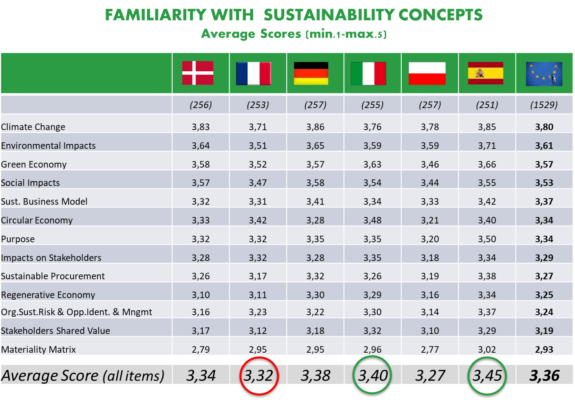
    In this section, responding managers were answering with little differences between the items, indicating a rather low familiarity with the issues.

    • France stands out for “I have the ability to identify the main relevant impacts, positive and negative, that my organisation generates on the entire ecosystem of stakeholders and I have capacity to measure, account and report Sustainability”.
    • Spain is noticeable for “I have capacity to measure, account and report Sustainability and I am able to develop and implement sustainable business models, that are oriented not only to profit, but which integrate people and planet Sustainability into long-term business strategies”.


    Context understanding skills of Senior Management

    Context Understanding skills is an area with one of the lowest result in the survey, both in the self-assessment as well as the assessment of Senior Management (see graphic below). Better understanding the context seems to be a priority area for developing trainings for managers.

    Excellent
    0%
    Good
    0%
    Average
    0%
    Below average and poor
    0%

    Members of CEC European Managers fare better in soft skills

    In a special complement to the research, it was found that managers affiliated to CEC European Managers generelly score better results for the skills, especially in the soft skill area. This may indicate that managers with a membership in trade unions or manager association benefit from better skill development than other managers.

    CEC Database

      General Survey

        Sustainable Leadership Behaviours

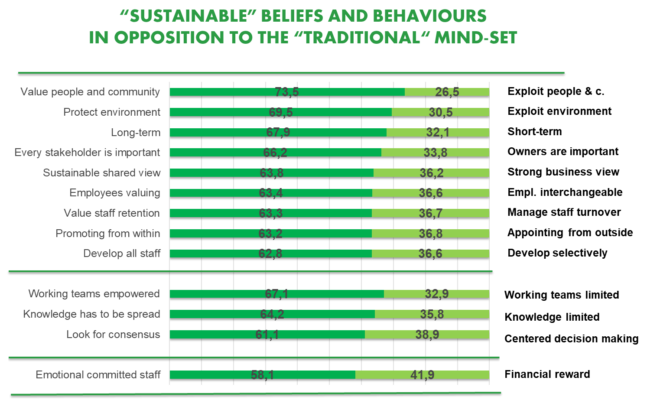
        Sustainable or traditional mind-set?

        Identification with Sustainable behaviours

        (figures for high self-identification)

        Practicing social dialogue
        0%
        Ensuring decent working conditions
        0%
        Compelling sustainability vision
        0%